
Choosing an ad platform is a bit like choosing between a magnet and a megaphone. Google pulls in people already looking. Meta shouts your message beautifully to people who might care. That’s the heart of google ads vs meta ads. One platform catches demand. The other creates curiosity.
For many businesses, the smartest answer isn’t one or the other. It’s knowing when each one earns its seat at the table. Google can support purchase-ready traffic, conversion tracking, and direct leads. Meta can build brand awareness, lookalike audiences, and scroll-stopping stories that people remember.
What Are Google Ads and Meta Ads?
Google Ads is Google’s main advertising platform for Search, YouTube, Gmail, Display, Shopping, Maps, Discover, and Performance Max. It started as Google AdWords, then grew into a wider system for search, video, shopping, and AI-assisted campaigns.
Meta Ads runs across Facebook, Instagram, Messenger, WhatsApp, and the Meta Audience Network. Instead of waiting for searches, it uses audience targeting, interests, behaviours, demographics, engagement, and creative signals to place ads in front of likely buyers.
Google Ads vs Meta Ads: The Core Difference
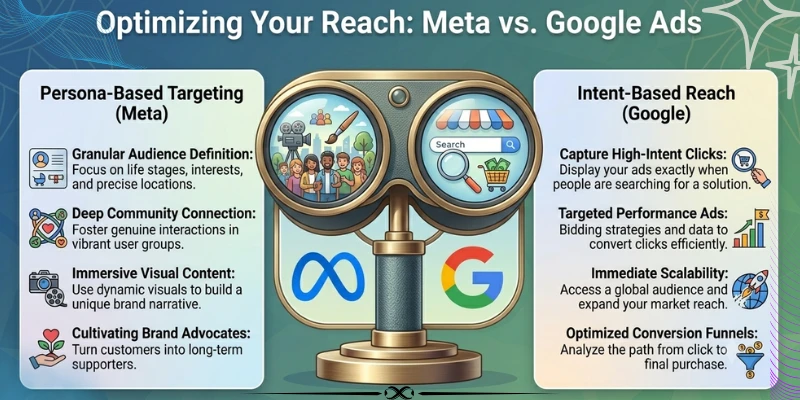
Here’s the cleanest answer: Google captures demand. Meta creates demand. Google works around search intent, meaning people already type what they want. That makes it strong for demand capture, urgent needs, service searches, and purchase-ready users.
Meta works like a smart shop window. People may not search yet, but strong visual creative can stop the scroll. That makes Meta useful for demand generation, upper-funnel awareness, mid-funnel education, and discovery-led advertising.
How Google and Meta Ads Work
Google uses keywords, search terms, Quality Score, ad copy, bids, landing pages, and conversion goals. Search campaigns match ads to user queries. Performance Max campaigns use Google AI and machine learning across Google inventory to find conversion opportunities.
According to the Google Ads Help, Performance Max can run one goal-based campaign across Search, YouTube, Display, Discover, Gmail, and Maps.
Meta uses campaign objectives, placements, ad creatives, audience signals, and optimisation. In Meta Ads Manager, you choose goals like awareness, traffic, engagement, leads, app promotion, or sales. Then Meta tests delivery across feeds, Reels, Stories, and messages.
Targeting Options Compared
Google targets what people search, where they are, which device they use, and how they behave online. You can use keyword targeting, location targeting, remarketing campaigns, custom audiences, demographic filters, and in-market audience signals.
Meta targets who people are and what they may care about. You can use interest targeting, behaviour targeting, lookalike audiences, custom audiences, and audience expansion. This makes Meta powerful when your buyer needs education before taking action.
| Targeting Area | Google Ads | Meta Ads |
|---|---|---|
| Main signal | Search query | User behaviour |
| Best strength | buyer intent | audience discovery |
| Retargeting | Strong | Strong |
| Lookalikes | Limited style | Very useful |
| Keywords | Core feature | Not core |
| Creative influence | Important | Very important |
Ad Formats and Placements Compared
Google offers search ads, display ads, YouTube Ads, shopping ads, app ads, and Performance Max campaigns. These work well when your product has clear demand. For example, “emergency plumber near me” usually fits Google better than a cold social feed ad.
Meta gives you Facebook Feed ads, Instagram Reels, Stories ads, carousel ads, image ads, video ads, lead generation ads, Messenger ads, and WhatsApp placements. Strong creative matters here. A dull ad dies fast. A scroll-stopper can print leads like a tiny machine.
Your ad creative needs sharp messaging, so professional content writing services can help turn clicks into real customer interest.
Your ad creative needs sharp messaging, and professional SEO content writing services can help create persuasive website content, landing pages, and supporting articles that turn visitors into customers.
Cost Comparison: Google and Meta Ads
Costs depend on industry, location, competition, bidding strategy, offer strength, and landing page quality. Google often has a higher cost per click because searchers show stronger intent. One click can cost more, but it may convert faster.
Meta often brings cheaper clicks and wider reach. However, cheap clicks don’t always mean cheap sales. Your cost per acquisition, CPA, and cost per conversion depend on creative quality, funnel design, USPs, trust, and how well your offer fits the audience.
Improving your website experience through professional on-page SEO services can also help search engines and visitors better understand your pages, leading to stronger rankings and better conversions.
| Cost Factor | Google Ads | Meta Ads |
|---|---|---|
| CPC | Often higher | Often lower |
| Conversion intent | Higher | Medium to high |
| Creative demand | Medium | Very high |
| Best use | Leads and sales | Awareness and retargeting |
| Budget risk | Expensive clicks | Weak traffic quality |
Before spending more on ads, improve your landing pages with on-page SEO services so visitors can trust, read, and convert faster.
However, conversion problems are not always caused by ads; professional technical SEO services can help fix website issues like speed, indexing, crawl errors, and performance barriers that affect results.
ROI and Conversion Quality
ROI depends on the funnel stage, not just the platform. Google often performs better for bottom-of-funnel searches because users already know their problem. That can improve lead quality, conversion rate, and return on ad spend.
Meta can build awareness, trust, and desire before the buyer searches later. This can increase branded search, assisted conversions, and customer lifetime value. Some marketers call this the Halo effect, where Meta lifts Google results indirectly.
“Don’t judge ads only by cheap clicks. Judge them by profitable customers.”
Strong ads can bring traffic, but a clean off-page SEO strategy helps build authority, trust, and long-term brand visibility.
To strengthen your online reputation beyond paid campaigns, strategic off-page SEO services can help build quality backlinks, increase authority, and improve organic search performance.
Quick Case Study Example
A dental clinic used Google for “teeth whitening near me” and Meta for before-and-after creative. Google brought direct bookings. Meta warmed cold audiences and filled retargeting pools. Together, both channels reduced wasted ad spend and improved lead quality.
Tracking, Reporting, and Attribution Differences
Tracking can get messy, especially when platforms report numbers differently. Google uses conversion tracking, Google Analytics, GA4, and Google Tag Manager. Meta uses Meta Pixel, event tracking, attribution windows, and view-through conversions.
According to the Meta for Business, Meta’s ad system uses the selected objective to find people across Facebook, Instagram, and Messenger who are more likely to take the desired action.
A common issue is the Meta Ads link clicks vs Google Analytics sessions discrepancy. Meta may count link clicks, while GA4 sessions need a real page visit. Slow loading pages, privacy settings, duplicate clicks, and attribution differences can create a tracking mismatch.
| Tracking Term | What It Means |
|---|---|
| Link clicks | Clicks on ad links in Meta |
| GA4 sessions | Website visits recorded by GA4 |
| CTR | Click-through rate |
| Attribution window | Time allowed for crediting conversions |
| View-through conversions | Conversions after an ad view |
| Impression share | Google visibility metric |
Which Platform Should You Choose for Your Business?
For local services, emergency jobs, B2B, SaaS, and high-intent searches, Google usually wins first. People searching for “roof repair,” “SEO agency,” or “lawyer near me” often need a solution now. That’s why purchase-ready traffic matters.
For ecommerce, fashion, beauty, coaching, restaurants, and new brands, Meta can shine. Products with strong visuals need creative testing, social proof, and repeated exposure. If you need small business advertising, compare demand, offer, and funnel maturity first.
Choose Google Ads If
Choose Google when people already search for your service. It works well for lead generation, urgent needs, local services, ecommerce shopping searches, and clear problem-solving offers. Strong landing pages and clean conversion data matter a lot.
Choose Meta Ads If
Choose Meta when your product needs discovery, storytelling, or visual proof. It works well for brand awareness, retargeting ads, lead forms, lifestyle products, education, and audience testing. Your creative variation can make or break results.
Should You Use Both Platforms Together?
Often, the best answer is not Meta Ads vs Google Ads. It’s both. Meta warms the cold audience. Google captures people when they search later. This creates a better omnichannel marketing flow across discovery, research, comparison, and conversion.
Modern buyers don’t move in a straight line. They scroll, save, ask friends, Google the brand, read reviews, and return later. A smart integrated approach lets Meta build familiarity while Google catches demand at the exact moment of search.
A successful marketing strategy needs more than paid traffic alone, which is why many businesses invest in overall SEO services to improve organic visibility, authority, and long-term growth.
Simple full-funnel flow:
- Meta builds brand awareness.
- Users visit your site.
- Retargeting brings them back.
- Google captures branded and service searches.
- Better tracking improves future decisions.
Paid ads work better when they support a full SEO strategy built around search visibility, content, tracking, and conversions.
Key Takeaways
So guys, in this article, we’ve covered “google ads vs meta ads” in detail. My honest advice is to choose Google Ads if you need faster high-intent leads, and choose Meta Ads if your product needs attention, education, and repeated exposure. For many businesses, the best answer is using both together.
However, avoid one common mistake: don’t copy the same message across both platforms. Google needs clear intent-based copy, while Meta needs strong creativity and emotion. Test your offer, improve your tracking, and review cost per conversion instead of only clicks. Now take what you’ve learned, explore google ads vs meta ads further, and build an ad strategy that actually moves your business forward.